


Sedona’s short-term rental market generates a median annual revenue of $75,000 per active listing, according to Airbtics data covering February 2025 through January 2026. Scottsdale hosts average $51,107 per year, per AirROI’s 2026 dataset. Yet thousands of Arizona owners operating these properties are doing so with the wrong insurance — and they’ll only find out when a claim is denied.
This guide explains exactly what vacation rental insurance is, what Arizona law requires, why homeowners and landlord policies routinely fail vacation rental hosts, what coverage actually costs, and how to structure a policy that protects your property, your income, and your personal assets.
What Vacation Rental Insurance Is — Through Real Arizona Scenarios
Vacation rental insurance, often called short-term rental insurance, is a specialized policy designed to cover homes rented to paying guests on a nightly or weekly basis — the kind of use typical of Airbnb, VRBO, Booking.com, and similar platforms. It is structured differently from a standard homeowners policy because the underlying risk is different: paying guests, high turnover, commercial income generation, and the property-entrustment exposure that comes with handing keys to strangers.
Under Arizona Revised Statutes § 9-500.39, Arizona cities and towns may require a vacation rental or short-term rental to “maintain liability insurance appropriate to cover the vacation rental or short-term rental in the aggregate of at least $500,000” — unless the property is advertised through an online lodging marketplace that provides equal or greater coverage. The same baseline appears in A.R.S. § 11-269.17 for counties. This makes Arizona one of the few states where liability insurance for vacation rentals is embedded directly in state statute.
A Concrete Example: The Scottsdale Host Who Thought AirCover Was Enough
Consider a Scottsdale owner renting a four-bedroom home on Airbnb. The property earns roughly $50,000 per year — in line with the AirROI-reported Scottsdale average of $51,107 annually. The host carries a standard HO-3 homeowners policy and relies on Airbnb’s AirCover program as a secondary safety net.
A guest slips on wet tile near the pool and sustains a serious back injury. The guest files a $250,000 liability claim. The homeowner submits it to their insurance carrier. The adjuster reviews the property address, finds the active Airbnb listing, and applies the policy’s business activity exclusion. The claim is denied. The host then discovers that AirCover is not licensed primary insurance but a platform protection program with its own limitations and exclusions — and the host is now personally exposed to the full liability.
This is not a hypothetical scenario. Published guidance from multiple licensed insurance professionals and documented carrier policy language confirms that virtually every standard homeowners policy — HO-3 and HO-5 — contains a business activity exclusion. Once paying guests are involved, coverage can be denied even for incidents that have nothing directly to do with the guests, such as a storm-damaged roof or a kitchen fire that occurred between bookings.
How Arizona’s Legal Framework Applies to Vacation Rental Owners
Arizona has a layered regulatory structure for short-term rentals. The state preempts local governments from banning short-term rentals outright, but A.R.S. § 9-500.39 authorizes cities and towns to impose specific registration, notification, and insurance requirements.
Statewide Insurance Minimum
The state statute authorizes municipalities to require vacation rental owners to carry at least $500,000 in aggregate liability coverage. Most cities have adopted exactly that threshold, while some — notably the Town of Paradise Valley — have gone higher.
City-by-City Insurance Requirements
Arizona’s largest short-term rental markets have adopted specific insurance requirements under their short-term rental ordinances:
- Phoenix — Ordinance G-7156 (effective November 2023) requires evidence of liability insurance of at least $500,000, or proof that the listing platform provides equal or greater coverage, as part of the short-term rental permit application submitted to the Planning and Development Department.
- Scottsdale — Ordinance 4566 regulates vacation rentals as residential properties rented for fewer than 30 days and incorporates the $500,000 minimum liability threshold through the city’s permitting framework.
- Sedona — Requires the $500,000 minimum liability coverage and imposes fines starting at $500, increasing to $3,500 for repeated violations of short-term rental ordinances.
- Paradise Valley — Section 10-14-5(B)(1)(a) of the town ordinance requires liability insurance of at least $1,000,000 in the aggregate — double the state-authorized floor — or equal or greater insurance through the online lodging marketplace.
- Lake Havasu City — Requires evidence of $500,000 liability coverage unless the listing platform provides equal or greater primary coverage. Annual permit renewal fee is $250.
What the Law Does Not Do
Arizona law does not prescribe what type of liability policy must be used, and it does not require property coverage, loss of income coverage, or guest-caused damage coverage. It only establishes a liability floor. That gap between what the statute requires and what a vacation rental owner actually needs for meaningful protection is where the real insurance decision lives.
The Homeowners Exclusion Gap That Catches Vacation Rental Owners Off Guard
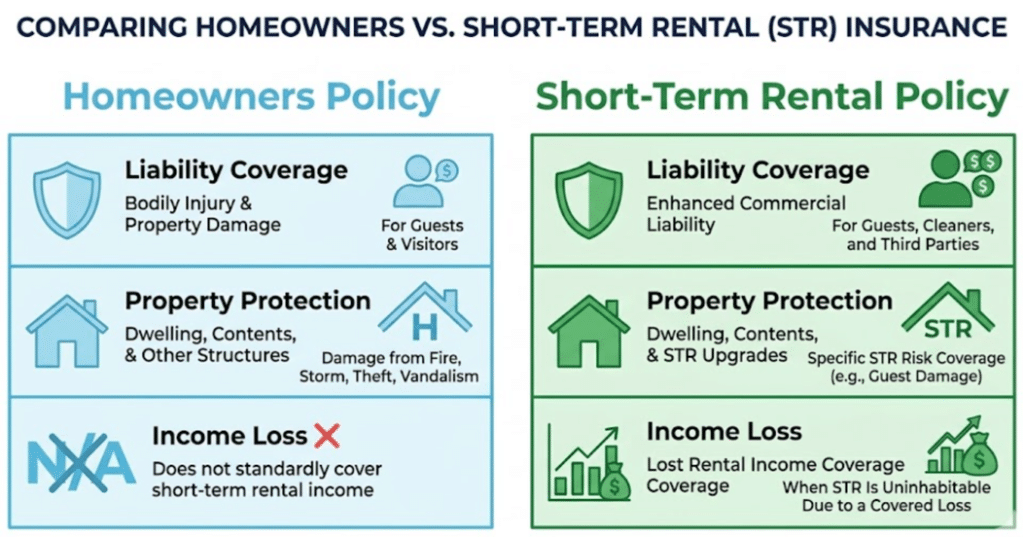
Standard homeowners insurance in Arizona — and nationally — contains what carriers and industry documentation describe as a business activity exclusion. Published insurance industry guidance documents the mechanics clearly: the exclusion grants the insurer the right to deny any claim at a property being used as a short-term rental, including claims that have no direct connection to a paying guest.
Four specific gaps appear repeatedly in documented claim denials for short-term rental properties:
- Liability claims tied to guests — Slip-and-fall injuries, hot-tub incidents, bunk-bed injuries, and similar guest injury claims are routinely denied under business activity exclusion language.
- Property damage during active rental use — Even claims not directly caused by a guest — a fire, a burst pipe, or storm damage — can be denied if the property is being actively used for short-term rental at the time of loss.
- Property entrustment damage — When a policyholder voluntarily gives possession of the property to a guest, many homeowners and landlord policies treat damage caused by that guest as an entrustment exclusion event. Theft, vandalism, and intentional guest damage are frequently denied under this clause.
- Loss of income — Homeowners policies do not include business income coverage. If the property becomes uninhabitable after a covered event, a homeowners policy’s loss-of-use coverage pays for the owner’s temporary housing — not the lost nightly revenue the property would have generated.
Published industry documentation also warns of the “habitability exclusion,” an endorsement in some commercial, landlord, and homeowners policies that strips liability coverage for any claim tied to the condition, safety, or livability of the property. Because most short-term rentals are homes built to residential rather than hospitality codes, this exclusion can trigger on minor code issues — a stair rail that doesn’t meet riser height requirements, a missing smoke detector, a window that fails egress standards.
Measurable Outcomes: Three Documented Scenarios
The financial consequences of operating an Arizona vacation rental without proper coverage are severe and well-documented. Consider three representative scenarios drawn from published claim patterns and Arizona-specific market data.
Scenario 1: The Denied Homeowners Claim
A Phoenix-area owner operates a three-bedroom Airbnb. Monthly revenue averages roughly $4,200 based on market rates reported for the greater Phoenix short-term rental market. A guest’s child breaks a glass shower door and sustains a deep laceration requiring surgery. The liability claim reaches $85,000 including medical, loss of wages, and pain-and-suffering damages. The owner’s homeowners carrier invokes the business activity exclusion and denies the claim. AirCover provides a partial payout that does not reach the full exposure. The owner faces the remaining balance plus legal defense costs out of pocket.
Scenario 2: The Fire With No Business Income Coverage
A Sedona property owner earning near the market median — Airbtics reports $75,000 median annual revenue for Sedona listings in the February 2025 through January 2026 window — experiences a kitchen fire between bookings. The fire is contained but the property is uninhabitable for four months. A homeowners policy would pay for the physical repair and for the owner’s alternative housing. But the $25,000 in booked revenue during those four months — already on the calendar — is not recoverable under a homeowners policy. The owner absorbs the income loss entirely.
Scenario 3: The Covered Outcome With a Commercial Policy
A Scottsdale owner, advised by an independent broker, carries a commercial short-term rental policy with $1,000,000 in liability, full replacement-cost property coverage, business income coverage, and guest property damage coverage. When a guest causes $14,000 in interior damage during a weekend booking and the property has to be taken off the market for three weeks of repairs, the policy pays for the physical damage, reimburses the $4,800 in lost nightly revenue during the repair window, and defends the owner against a third-party claim from the next booked guest whose stay was canceled. Total coverage paid: approximately $22,000. Total out-of-pocket to the owner: the deductible.
What Vacation Rental Insurance Costs in Arizona

The cost of a vacation rental policy in Arizona depends on several property-specific factors. Based on published industry guidance for the Arizona short-term rental insurance market, the major cost drivers are:
- Location and regional risk exposure — Phoenix metro, Scottsdale, and Sedona markets carry different underwriting profiles than rural Yuma or Lake Havasu City.
- Property type and construction — single-family homes, condos, townhouses, and small multifamily buildings are rated differently.
- Occupancy and booking frequency — higher turnover means higher exposure and higher premium.
- Claims history — prior losses increase pricing and can limit availability of carriers willing to quote.
- Coverage limits and deductibles — higher limits and lower deductibles increase premium.
- Amenities — pools, hot tubs, trampolines, and ATVs on-site materially affect liability rating.
Industry benchmarks place most single-family Arizona vacation rental policies in a range roughly 15% to 25% above a comparable landlord policy for the same property, reflecting the higher risk profile of nightly-turnover commercial use. For a typical single-family home in the Phoenix metro, published landlord insurance industry guidance puts annual premiums in the broader $1,200 to $3,000 range for a dedicated vacation rental policy, depending on the factors above — with higher-value Scottsdale and Sedona properties at the upper end and smaller Tucson or Mesa properties at the lower end.
The math is worth stating plainly. On a Scottsdale property averaging $51,107 in annual Airbnb revenue (AirROI 2026 data), a $2,000 annual premium represents roughly 3.9% of gross revenue. On a Sedona property at the $75,000 median annual revenue reported by Airbtics, a $2,500 annual premium is approximately 3.3% of gross. Against a single denied $85,000 liability claim, either figure is trivial.
Comparing Coverage Approaches for Arizona Vacation Rental Owners
Not every vacation rental property needs the same policy structure. Published insurance industry guidance identifies four distinct approaches Arizona owners use, each with documented strengths and documented gaps.
Approach 1: Keep the Homeowners Policy and Rely on Platform Protection
This is the most common approach — and the highest-risk. The owner keeps their existing HO-3 or HO-5 and assumes AirCover or VRBO’s host protection fills the gap. Published documentation is consistent that platform protections are generally structured as secondary coverage with significant exclusions — they typically exclude intentional guest damage, wear and tear, and certain personal injury categories, and they require claim submission within short windows with substantial documentation. They are not a substitute for primary insurance. For any Arizona city with a $500,000 or higher liability requirement, the owner also risks being out of compliance with local ordinance if the platform’s coverage falls short of the requirement for that specific booking.
Approach 2: Add a Home-Sharing Endorsement to the Homeowners Policy
Some Arizona homeowners carriers offer a home-sharing endorsement that extends limited coverage for occasional rental activity. Published industry guidance is clear on the limits of this approach: endorsements typically cap the number of rental days per year, may exclude detached ADU or casita use, and frequently do not fill the property-entrustment, business-income, or commercial-liability gaps. They can work for an owner who rents a room in their primary residence two or three weekends a year. They generally do not work for an owner running a dedicated vacation rental as a business.
Approach 3: Convert to a Landlord (DP-3) Policy
A landlord or dwelling fire policy is built for tenant-occupied rental property, typically with leases of six months or more. Published industry documentation confirms that standard DP-3 landlord policies usually exclude short-term rental use and often contain the same business activity exclusion language found in homeowners policies. A landlord policy alone is not the right fit for an Airbnb or VRBO operation.
Approach 4: Dedicated Vacation Rental / Commercial Short-Term Rental Policy
This is the approach that aligns coverage with the actual risk profile of the business. A dedicated vacation rental policy combines property coverage, commercial general liability (typically $1,000,000 per occurrence and up), loss of business income coverage, guest property damage, property entrustment coverage, and amenity-specific liability for pools, hot tubs, and similar features. For most Arizona owners operating dedicated short-term rental properties — whether in Phoenix, Scottsdale, Sedona, Tucson, Flagstaff, or Lake Havasu City — this is the structurally correct fit. An independent broker with access to multiple carriers can identify which one offers the best combination of coverage breadth and premium for the specific property and operating pattern.
Practical Implementation Guide for Arizona Vacation Rental Owners
Based on documented Arizona regulatory requirements and insurance industry best practices, the following process helps owners put the right policy in place.
Step 1: Document Your Actual Rental Use (Week 1)
Before requesting quotes, build a clear picture of how the property operates. Carriers will ask for these facts and will underwrite against them.
- Is the property a primary residence, a second home, or a dedicated investment property?
- How many nights per year is it booked, and what is the projected annual gross revenue?
- Is the property listed on Airbnb, VRBO, Booking.com, directly, or through a property manager?
- Does the property include a pool, hot tub, trampoline, game room, ATVs, bicycles, kayaks, or any other amenity?
- Is the property a single-family home, condo, townhouse, ADU, casita, or part of an HOA with restrictions?
Step 2: Verify the Local Municipal Requirements (Week 1)
Arizona’s short-term rental rules vary by city and county. Confirm the specific insurance floor, permit renewal cycle, and notification requirements that apply to the property’s address — Phoenix, Scottsdale, Sedona, Paradise Valley, Mesa, Tucson, Lake Havasu City, and Flagstaff each have their own ordinances. Where Paradise Valley requires $1,000,000, most others require $500,000; underwriting the wrong floor creates a permit compliance problem.
Step 3: Audit the Current Policy (Week 2)
Pull the current homeowners, landlord, or condo policy and look specifically for three things:
- The “Business Pursuits” or “Business Activity” exclusion — typically in the general exclusions section of the policy.
- Any short-term rental or home-sharing endorsement and its day-count and revenue caps.
- Any property entrustment or habitability exclusion language.
If the policy is silent on short-term rental use, call the carrier and ask in writing whether the documented rental activity is covered. A verbal “should be fine” from an agent does not bind the carrier at claim time.
Step 4: Work With an Independent Broker to Compare Carriers (Weeks 2–3)
Short-term rental insurance is a specialized product, and not every carrier writes it — or writes it well. Commercial short-term rental policies, commercial homeowners policies, and specialty vacation rental programs each have different coverage structures. An independent broker with access to multiple carriers can compare the actual policy language across options, not just the premium.
When requesting quotes, supply the broker with:
- Property address, year built, square footage, number of bedrooms and bathrooms.
- Construction details and roof age (critical for Arizona monsoon and wildfire underwriting).
- Full amenity list, including pools, hot tubs, and any watercraft or vehicles on-site.
- Projected annual rental revenue and booking platforms used.
- Desired liability limit (a minimum of $1,000,000 per occurrence is recommended for most dedicated rentals; match or exceed the local ordinance floor).
- Any prior claims history on the property.
Step 5: Evaluate Required Coverage Components (Week 3)
A complete Arizona vacation rental policy should include, at minimum:
- Dwelling coverage on a replacement-cost basis, at the full rebuild cost of the structure.
- Other structures coverage for detached casitas, guesthouses, sheds, and outbuildings.
- Contents / business personal property coverage for the furnishings, appliances, electronics, and linens provided for guest use.
- Commercial general liability of at least $1,000,000 per occurrence, meeting or exceeding the local ordinance requirement.
- Loss of business income / loss of rents coverage that reimburses actual booked revenue, not just fair-market rent.
- Property entrustment or guest-caused damage coverage that does not rely on the entrustment exclusion to deny claims.
- Amenity liability extensions for pools, hot tubs, and any sporting equipment provided for guest use.
- Monsoon wind and hail coverage — confirm that the policy’s wind/hail deductible is manageable given Arizona’s monsoon season.
Step 6: Bind Coverage and File for Your Permit (Week 4)
Once a policy is bound, request a Certificate of Insurance (COI) showing the carrier, policy number, effective dates, and liability limits. Arizona cities require this documentation as part of the short-term rental permit application. Upload the COI with the permit application, keep a copy with the rental license, and post the permit number on all online listings as required by most city ordinances.
Conclusion: Your Arizona Vacation Rental Is a Business — Insure It Like One
The Scottsdale host described at the opening of this article — the one who assumed a homeowners policy and AirCover were enough — is not an unusual case. Across Arizona’s roughly 1,700 active Sedona listings, 4,100 active Scottsdale listings, and the thousands of Airbnb and VRBO properties across Phoenix, Tucson, Mesa, Flagstaff, and Lake Havasu City, a significant share are operating with coverage that will fail at the worst possible moment.
Arizona law, through A.R.S. § 9-500.39 and § 11-269.17, authorizes municipalities to require at least $500,000 in aggregate liability coverage for vacation rentals — and Paradise Valley pushes that to $1,000,000. But the legal floor is not the coverage target. The target is a policy structured for the actual business: guest injuries, property entrustment, business income, amenity liability, and the monsoon and wildfire exposures unique to Arizona.
The single most effective next step: contact an independent insurance broker with experience in the Arizona short-term rental market and request a dedicated vacation rental quote. Independent Insurance Brokers of Arizona (IIB Arizona) compares coverage across multiple carriers to match the right vacation rental policy to the specific property, local ordinance, and rental pattern — without requiring the owner to shop each carrier individually. Visit iibarizona.com to get a free vacation rental insurance quote and confirm your property is properly protected.
Frequently Asked Questions
Does my Arizona homeowners insurance cover my Airbnb or VRBO?
Almost always no. Published industry documentation confirms that standard HO-3 and HO-5 homeowners policies contain a business activity exclusion that can trigger a denial for any claim — liability or property — once paying guests are involved. Some carriers offer a limited home-sharing endorsement for occasional rentals, but dedicated short-term rentals typically need a vacation rental or commercial policy.
How much liability coverage does Arizona law require for a vacation rental?
Arizona Revised Statutes § 9-500.39 authorizes cities to require at least $500,000 in aggregate liability coverage — or equivalent coverage through the listing platform. Paradise Valley requires $1,000,000. Phoenix, Scottsdale, Sedona, and Lake Havasu City generally use the $500,000 floor. Always verify the current requirement with the specific municipality.
Is AirCover or VRBO host protection enough insurance for my Arizona vacation rental?
No. Published documentation is consistent that platform host-protection programs are secondary coverage with significant exclusions — intentional guest damage, wear and tear, certain personal-injury categories, and more. They are not licensed primary insurance and should not be used as a substitute for a dedicated vacation rental policy.
How much does vacation rental insurance cost in Arizona?
Most dedicated Arizona vacation rental policies fall in a range of roughly $1,200 to $3,000 per year for a single-family home, depending on property value, location, amenities, rental frequency, and claims history. Larger Scottsdale and Sedona luxury properties price higher; smaller Tucson and Mesa properties price lower. An independent broker can produce a precise quote for a specific property.
Do I need vacation rental insurance if I only rent my home a few weeks a year?
Possibly yes — it depends on the policy and the city. A home-sharing endorsement on a homeowners policy may cover truly occasional use, but local ordinances like Phoenix Ordinance G-7156 require liability coverage for any permitted short-term rental activity. Confirm both the carrier’s endorsement limits and the local municipal requirement before relying on an endorsement alone.
Sources & Disclaimer
This article references publicly available information from the Arizona Department of Insurance and Financial Institutions (DIFI), Arizona Revised Statutes (A.R.S. § 9-500.39 and § 11-269.17), the City of Phoenix (Ordinance G-7156), the City of Scottsdale (Ordinance 4566), the City of Sedona short-term rental ordinance, the Town of Paradise Valley (Section 10-14-5), Lake Havasu City short-term rental permit requirements, published short-term rental market data from AirDNA, AirROI, Rabbu, and Airbtics, and published short-term rental insurance industry guidance. Sources are dated between 2022 and 2026. All metrics and legal citations are drawn from documented public sources. Results described in illustrative scenarios are representative of documented claim patterns and may vary based on individual policy terms, insurer underwriting decisions, and the specific facts of each claim. Insurance coverage, rates, and regulatory requirements change frequently — for current Arizona insurance guidance, consult the Arizona DIFI at difi.az.gov. For current product and coverage information from Independent Insurance Brokers of Arizona, visit iibarizona.com.