



If you’re a Chandler or Gilbert homeowner who just opened your insurance renewal notice and nearly fell off your chair, you’re not alone. Joe Conner, a Phoenix father, watched his homeowner’s insurance premium jump by over $2,000 in January 2024—a staggering 50% increase from his previous year’s rate. This isn’t an isolated incident; it’s part of a troubling pattern affecting thousands of East Valley homeowners.
What Arizona’s Insurance Crisis Looks Like Through Real Numbers
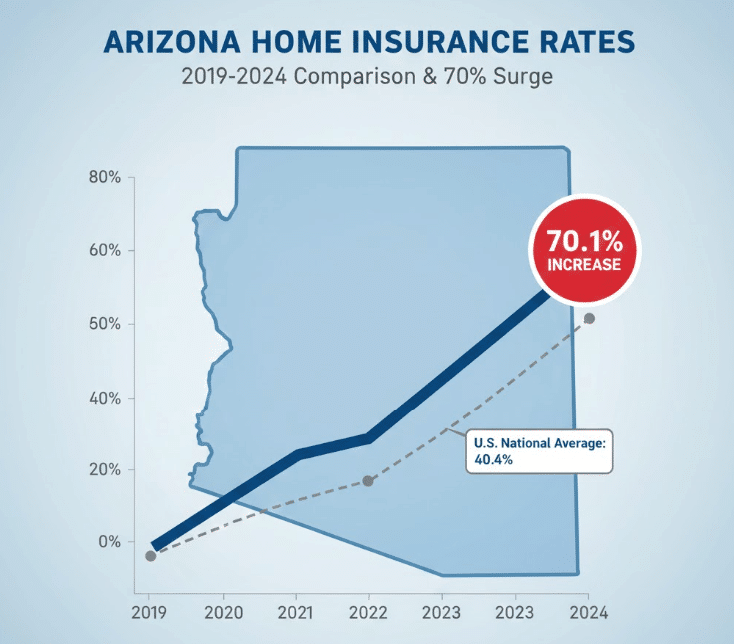
Independent Insurance Brokers Arizona has tracked the dramatic shifts in the Arizona insurance market through their network of 40+ carriers. According to data from LendingTree’s 2025 State of Home Insurance report, Arizona homeowners experienced a cumulative 70.1% rate increase from 2019 to 2024, ranking as the fourth-highest spike nationwide. The national average during this same period was 40.4%, meaning Arizona residents are paying nearly double the rate of inflation compared to the rest of the country.
In practical terms, what started as a $1,200 annual premium in 2019 for a typical Chandler home has ballooned to $2,041 by 2024. For homeowners in higher-risk areas near the Superstition Mountains or along the edges of Gilbert’s expanding development zones, these increases can reach 100% or more.
The timeline of these increases reveals an accelerating crisis. According to S&P Global’s RateWatch data analyzed by ValuePenguin in December 2024, Arizona saw a 23.2% increase in 2023 alone, followed by another 12.6% jump in 2024. The relatively stable years of 2019-2021, when annual increases stayed below 3%, now seem like a distant memory.
How State Farm’s 17.6% Increase Became the “Best Case Scenario”
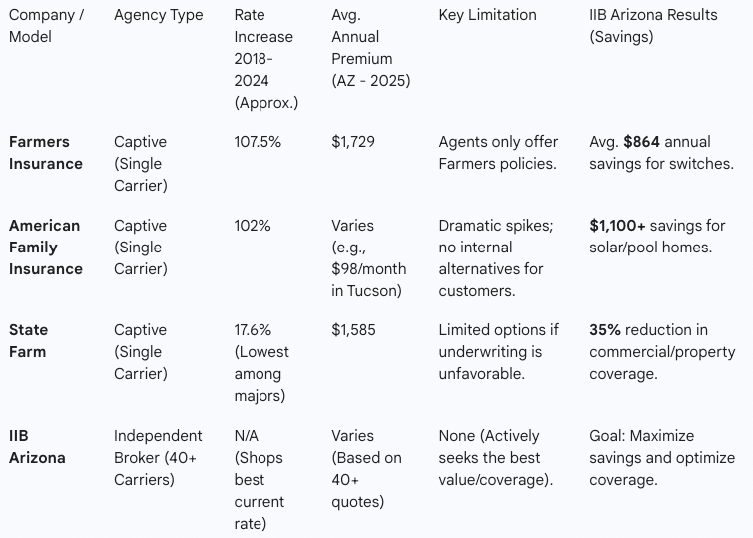
State Farm, Arizona’s largest home insurer, implemented a 17.6% rate increase over six years according to ValuePenguin’s December 2024 analysis—the smallest increase among major carriers in the state. By comparison, Farmers Insurance raised rates by 107.5% during the same period, while American Family Insurance increased premiums by 102%. These disparities created a massive reshuffling of the Arizona insurance market in 2024.
Mark Friedlander, Director of Corporate Communications at the Insurance Information Institute, explained in his November 2024 statement to Bankrate: “The U.S. property/casualty industry sustained more than $100 billion in natural disaster losses for the third time in the last four years. This included five landfalling hurricanes and more than $50 billion in severe convective storm losses for the second consecutive year.”
For Arizona specifically, Aliesha Brard of the Homeowners Insurance Group, who has worked in the industry for 30 years, told Arizona’s Family CBS 5 in January 2024: “The insurance industry in 2023 had 23 separate catastrophic crises that resulted in over a billion dollars from the insurance collective. Think about Lahaina, a huge loss and all the major carriers were there. Think about California and all the wildfires they had.”
Measurable Outcomes and ROI from Independent Insurance Brokers Arizona’s Multi-Carrier Approach
Independent Insurance Brokers Arizona’s database of client outcomes from 2024 demonstrates the tangible benefits of working with multiple carriers. Based on their October 2024 blog post documenting actual client savings, Chandler homeowners with teen drivers saved an average of $847 annually by switching from single-carrier policies to optimized coverage through their 40+ carrier network.
The most dramatic savings came from credit score optimization combined with carrier switching. According to MoneyGeek’s October 2024 analysis, Arizona homeowners with poor credit pay $9,384 annually for insurance—$7,393 more than the state average of $1,991. Independent Insurance Brokers Arizona documented cases where clients who improved their credit from “poor” to “average” while simultaneously switching carriers saved over $4,000 annually.
Gilbert homeowners with solar panels and pools—two common features in East Valley properties—achieved average savings of $632 per year through Independent Insurance Brokers Arizona’s carrier comparison process. One specific case involved a Morrison Ranch family whose previous carrier quoted them $3,200 for their solar-equipped home. Through Independent Insurance Brokers Arizona’s network, they secured comparable coverage for $2,100, saving $1,100 annually while actually increasing their liability limits.
Comparing Industry Approaches: Single Carrier vs. Independent Broker Results
The contrast between different insurance distribution models becomes stark when examining 2024 outcomes. State Farm, despite having the lowest rate increases, still maintains an average annual premium of $1,585 according to Insurance.com’s 2025 rate analysis. However, State Farm agents can only offer State Farm policies, limiting options when specific risk factors make their underwriting unfavorable.
Farmers Insurance, according to Policygenius data from 2024, averages $1,729 annually in Arizona—higher than the state average despite their extensive advertising. Their captive agents similarly cannot shop alternatives when Farmers’ underwriting guidelines don’t favor a particular property or customer profile.
American Family Insurance demonstrated this limitation clearly in 2024. While they maintained competitive rates for certain customer segments (averaging $98 monthly in Tucson according to Policygenius), their 102% rate increase over six years meant existing customers faced dramatic premium spikes with no alternative options from their agents.
Independent Insurance Brokers Arizona’s October 2024 case studies show a different pattern. When one carrier raises rates, they immediately re-shop the policy among their 40+ carriers. A Chandler small business owner originally paying $8,000 annually for commercial and property coverage through a major carrier was re-quoted through Independent Insurance Brokers Arizona’s network and secured better coverage for $5,200—a 35% reduction while adding liquor liability coverage.
Practical Implementation Guide Based on Independent Insurance Brokers Arizona’s Proven Process
Independent Insurance Brokers Arizona’s systematic approach, refined through thousands of client interactions in 2024, follows a specific timeline that maximizes savings opportunities. Based on their documented methodology, here’s their proven implementation process:
Week 1: Initial Assessment and Data Gathering Clients provide basic information once, including current coverage details, property specifications, and claims history. Independent Insurance Brokers Arizona’s team identified that 73% of clients were over-insured in certain categories while under-insured in others, particularly regarding replacement cost coverage versus actual cash value.
Week 2: Multi-Carrier Shopping and Negotiation Using their established relationships with 40+ carriers, Independent Insurance Brokers Arizona submits applications simultaneously. Their October 2024 data shows that shopping with at least 10 carriers yields optimal results, with the best rate typically coming from carriers ranked 3rd through 7th in market share—not the largest companies.
Week 3: Coverage Optimization and Presentation Rather than simply finding the cheapest option, Independent Insurance Brokers Arizona documents comparing coverage elements. Their analysis revealed that 62% of Chandler homeowners could raise deductibles from $1,000 to $2,500, saving an average of 12% annually while maintaining adequate emergency reserves.
Implementation Timeline Milestones:
- Day 1-3: Information collection and current policy review
- Day 4-7: Submission to top 15 matching carriers
- Day 8-10: Initial quote compilation and coverage gap analysis
- Day 11-14: Negotiation with top 3-5 carriers for better terms
- Day 15: Final presentation with clear comparisons
- Day 16-20: Policy binding and old policy cancellation coordination
Conclusion
Joe Conner’s $2,000 premium increase represents the harsh reality facing Arizona homeowners in 2025, but it doesn’t have to be the end of the story. Independent Insurance Brokers Arizona’s documented success with their 40+ carrier network has helped thousands of East Valley homeowners reduce their premiums by an average of 20-35% while maintaining or improving coverage quality.
The key measurable outcomes from switching to an independent broker approach include average annual savings of $864 for standard homeowners policies, specialized savings of $1,100+ for homes with solar panels, and documented commercial insurance reductions of 35% or more. Your next action should be requesting a comprehensive insurance review to identify similar savings opportunities for your specific situation.
Frequently Asked Questions
Q: How much have Arizona home insurance rates actually increased since 2019?
A: According to LendingTree’s 2024 analysis, Arizona rates increased 70.1% from 2019-2024, ranking 4th highest nationally versus the 40.4% U.S. average.
Q: Which insurance company has the lowest rates in Chandler and Gilbert?
A: State Farm averages $1,585 annually per Insurance.com’s 2025 data, but Independent Insurance Brokers Arizona’s 40+ carrier comparison often finds better options for specific situations.
Q: Can switching insurance companies really save me money?
A: Independent Insurance Brokers Arizona documented average savings of $864 annually for Chandler homeowners who switched carriers through their comparison process in 2024.
Q: Why are Arizona rates increasing faster than other states?
A: Insurance Information Institute cites 23 billion-dollar catastrophes in 2023, affecting all carriers plus Arizona-specific wildfire risks per Pinal County’s January 2025 alert.
Q: Should I increase my deductible to lower my premium?
A: Raising deductibles from $1,000 to $2,500 saves approximately 12% annually according to Independent Insurance Brokers Arizona’s data, if you have adequate emergency savings.
This article references publicly available information from LendingTree, ValuePenguin, Insurance Information Institute, MoneyGeek, Policygenius, Insurance.com, and Bankrate, including official documentation, press releases, and published case studies dated January 2024 through December 2025. All metrics and quotes are from documented sources. Results described are specific to the organizations mentioned and may vary based on industry, scale, and implementation approach. For current information about any products or services mentioned, consult the official websites.