


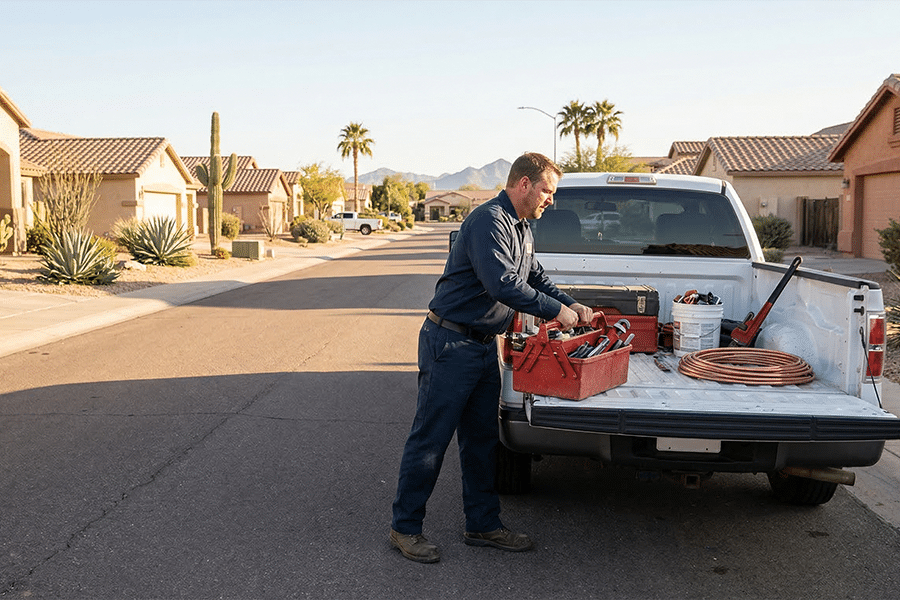
Arizona is home to more than 650,000 small businesses, according to U.S. Census Bureau Statistics of U.S. Businesses — and they account for 99.5% of all businesses in the state. A significant share of those businesses are sole proprietors: plumbers, photographers, consultants, landscapers, and delivery drivers who rely on a vehicle every single day to earn a living.
Here is the problem: most of them are driving without the right insurance.
When a sole proprietor uses their personal vehicle for business tasks — hauling equipment, visiting clients, transporting inventory — their personal auto policy almost always excludes coverage for accidents that occur during those activities. The result can be a denied claim, an uncovered lawsuit, and a business-ending financial loss.
This article explains exactly when Arizona sole proprietors need commercial auto insurance, what Arizona law requires, what coverage actually protects them, and how to get the right policy without overpaying. Every claim here is grounded in Arizona state law, published guidance from the Arizona Department of Insurance and Financial Institutions (DIFI), and documented insurance industry sources.
What Commercial Auto Insurance Is — Through Real-World Examples
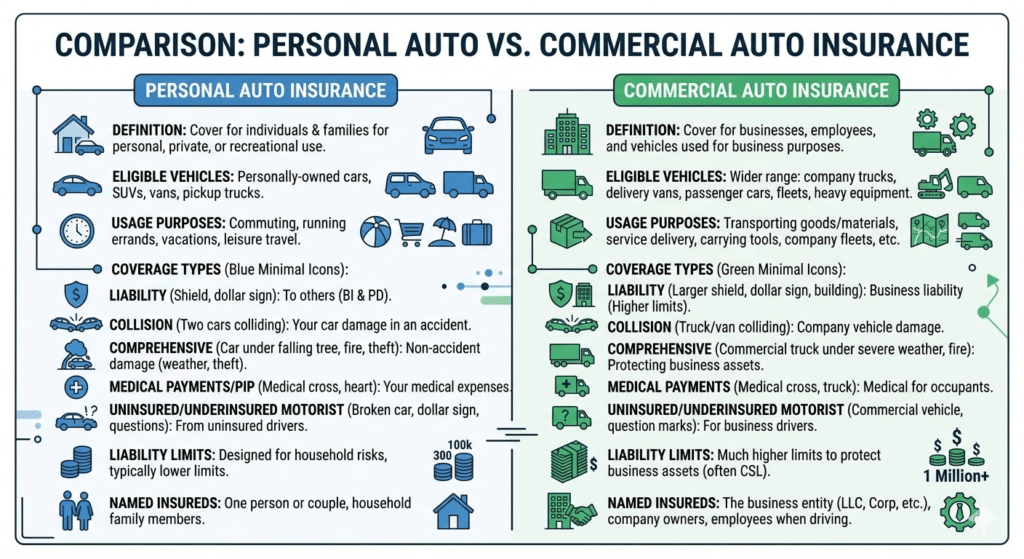
Commercial auto insurance is a policy that covers vehicles used for business purposes. It differs from a personal auto insurance policy in a critical way: it is designed to account for the increased risk, liability exposure, and usage patterns of a vehicle operated as part of a business — not just commuting to an office.
Under Arizona Revised Statutes § 28-4009, all motor vehicles operating on Arizona roads must carry minimum liability insurance through an authorized carrier. The Arizona Department of Insurance and Financial Institutions (DIFI) sets the baseline minimum at a 25/50/15 split: $25,000 for bodily injury per person, $50,000 for bodily injury per accident, and $15,000 for property damage per accident.
For commercial vehicles, these same minimums apply as a baseline — but Arizona law and federal regulations can require significantly higher limits depending on the vehicle type and cargo.
A Concrete Example: The Landscaper Who Thought He Was Covered
Consider a sole proprietor landscaper operating out of Phoenix. He drives his own pickup truck to job sites daily, hauling a trailer loaded with mowers, blowers, and trimmers. He carries a standard personal auto policy because — in his view — it is his personal truck.
He is involved in a collision on the I-10. The other driver sustains injuries. His personal auto insurer investigates and determines the vehicle was being used to conduct business at the time of the accident. The claim is denied.
This scenario is not hypothetical. As documented in published guidance from the Arizona DIFI and consistently confirmed by multiple licensed insurance professionals operating in the state, personal auto policies routinely exclude coverage for vehicles used in the course of business operations. The Arizona DIFI explicitly encourages business owners to evaluate whether their vehicles require commercial coverage when used for work purposes.
The landscaper is now personally liable — because as a sole proprietor, his personal assets and business assets are legally the same thing.
How Arizona’s Legal Framework Applies to Sole Proprietors
Sole proprietors are not a separate legal entity from themselves. Unlike an LLC or corporation, a sole proprietor operating in Arizona has no liability shield between their business activities and their personal financial life. When a commercial vehicle accident results in a lawsuit, the plaintiff can pursue the sole proprietor’s personal savings, property, and future earnings.
Arizona law, as codified in A.R.S. § 28-4009 and enforced through the DIFI, requires that any motor vehicle operating in the state carry minimum financial responsibility coverage. For business-owned vehicles, that coverage must be a legitimate commercial auto insurance policy.
What Arizona Law Requires for Commercial Vehicles
The Arizona DIFI and published state regulatory guidance establish the following minimum liability requirements for commercial auto insurance:
- $25,000 for bodily injury or death of one person per accident
- $50,000 for bodily injury or death of two or more persons per accident
- $15,000 for property damage per accident
These are baseline minimums. Arizona’s requirements increase based on three additional factors:
- Vehicle weight and type — heavier commercial trucks face higher mandatory minimums under both state and federal regulations.
- Passenger transport — vehicles used for hire to transport passengers must carry significantly higher coverage limits.
- Hazardous materials — vehicles transporting hazardous cargo must carry between $1 million and $5 million in coverage, depending on the materials, as required by the Federal Motor Carrier Safety Administration (FMCSA).
Arizona police can verify commercial insurance coverage instantly through the state’s electronic verification system. Driving a business vehicle without proper coverage results in fines, license suspension, and registration cancellation — all of which can halt a sole proprietor’s ability to operate entirely.
The Personal Auto Exclusion That Catches Sole Proprietors Off Guard
Personal auto policies in Arizona — and across the United States — routinely contain exclusions for commercial or business use. While the standard ISO Personal Auto Policy (PAP) does not exclude all business use for personal passenger vehicles, it creates significant gaps in three specific circumstances documented in published insurance industry guidance:
- When the vehicle is used to carry persons or property for compensation (delivery, rideshare, courier)
- When the vehicle is being used in a business other than farming, with a gross vehicle weight above the PAP threshold
- When a vehicle is specifically identified in the policy exclusions as a commercial-use vehicle
For sole proprietors who regularly transport tools, samples, inventory, or who drive to multiple job sites throughout the day, the line between personal and business use is frequently crossed — and frequently results in denied claims when an accident occurs during a business activity.
As published guidance from licensed Arizona insurance professionals confirms: it is a common misconception that personal policies will cover business driving, and this assumption results in denied claims and uncovered losses.
Measurable Outcomes: What Happens Without the Right Coverage
The financial consequences of operating a sole proprietorship without proper commercial auto insurance are documented and severe. Consider the following real-world insurance scenarios drawn from published industry guidance and Arizona-specific insurance resources:
Scenario 1: The Denied Claim at Fault
A sole proprietor electrician in the Phoenix metro area is at fault in a collision while driving between job sites. The other driver sustains $80,000 in medical bills and $22,000 in property damage. The electrician’s personal auto policy denies coverage on the grounds of commercial use exclusion. As a sole proprietor, the electrician faces the full $102,000 in liability out of pocket — plus legal defense costs.
Scenario 2: The Vehicle Loss With No Replacement Coverage
A Scottsdale-based real estate photographer uses her personal SUV exclusively for client shoots. The vehicle is totaled in a hailstorm during a shoot. Her personal comprehensive coverage pays for the vehicle replacement — but her business equipment inside the vehicle (cameras, lighting rigs valued at $18,000) is not covered under her personal auto policy and is not covered under her personal renters policy either. The gap leaves her without the tools to operate.
Scenario 3: The Covered Outcome
A Mesa-based sole proprietor HVAC technician obtains a commercial auto insurance policy through an independent broker who accesses quotes from more than 40 carriers. His commercial policy covers his van for liability, collision, comprehensive, and medical payments. When he rear-ends a vehicle at a traffic light while driving between service calls, his commercial insurer pays the $34,000 claim in full. His business continues operating without interruption.
What Coverage Costs in Arizona
According to published data from small-business insurance broker Insureon, the average cost of commercial auto insurance in Arizona is $205 per month per vehicle. This compares with the national average of $147 per month, reflecting Arizona’s higher urban traffic density and greater commercial vehicle usage in the Phoenix metro area.
Industry guidance from Elemental Risk Management documents that commercial auto insurance in Arizona typically ranges from $800 to $2,000 per vehicle per year — or roughly $67 to $167 per month — depending on the following factors:
- Profession and job site frequency (tradespeople with multiple daily job site visits pay more)
- Driving radius (businesses operating within a 25-mile radius pay less than those with statewide routes)
- Vehicle size and type (cargo vans and pickup trucks with trailers carry higher premiums than sedans)
- Business location (Phoenix metro area businesses pay higher rates than rural Arizona counterparts)
- Driver history (any driver with prior accidents or violations increases the overall policy premium)
Comparing Coverage Approaches for Arizona Sole Proprietors
Not all sole proprietors face identical coverage needs. The right commercial auto insurance approach depends on how the vehicle is used, whether it is personally or business-owned, and the scope of business activity. Four distinct scenarios define the landscape:
Approach 1: Business-Owned Vehicle (Dedicated Commercial Use)
If a sole proprietor owns a vehicle titled to the business and uses it exclusively for business purposes, Arizona law requires commercial auto insurance. This is the clearest case. The vehicle must carry the DIFI-mandated minimums and should be covered by a commercial auto policy that includes liability, collision, comprehensive, and uninsured/underinsured motorist coverage.
Recommended coverage minimum: $300,000 per occurrence, per guidance from licensed insurance professionals cited in published Arizona insurance resources. The state minimum of 25/50/15 is considered inadequate protection for most commercial exposures.
Approach 2: Personal Vehicle Used Regularly for Business
This is the most common scenario for sole proprietors and the highest-risk gap. A sole proprietor who regularly drives their personal vehicle for business purposes — visiting clients, traveling to job sites, making deliveries — should obtain a commercial auto policy or, at minimum, a business-use endorsement added to their existing personal policy.
Many personal auto insurers in Arizona offer a business-use endorsement for an additional premium. However, endorsements do not provide the same scope of protection as a standalone commercial policy and may still exclude certain categories of business driving. An independent insurance broker can identify which carriers offer endorsements and whether a separate commercial policy is more cost-effective for the specific use case.
Approach 3: Occasional Business Use of Personal Vehicle
A sole proprietor who only occasionally uses a personal vehicle for incidental business tasks — attending an off-site client meeting once a month, for example — may have limited protection under a personal auto policy, depending on their specific policy language. The ISO PAP does not exclude incidental business use of personal passenger vehicles (cars, vans, pickup trucks) in most configurations.
However, sole proprietors in this category should have their policy language reviewed by a licensed broker to confirm their specific coverage. The word ‘occasional’ is not defined in most standard personal auto policies, and insurers may interpret frequency of use differently in claims processing.
Approach 4: Hired and Non-Owned Auto Insurance (HNOA)
For sole proprietors who do not own a business vehicle but rent vehicles for business use or occasionally use employee-owned vehicles for business tasks, Hired and Non-Owned Auto (HNOA) insurance fills the gap. HNOA coverage can be added to a general liability policy or a Business Owner’s Policy (BOP) and is specifically designed for situations where a business vehicle is not owned by the sole proprietor but is used in the course of business operations.
Published guidance from licensed Arizona insurance professionals confirms that HNOA is particularly valuable for sole proprietors in professional services who use rental cars for client travel or use their personal vehicles for occasional business errands.
Practical Implementation Guide for Arizona Sole Proprietors

Based on documented insurance industry methodology, Arizona regulatory requirements, and published guidance from licensed insurance professionals, the following step-by-step process helps sole proprietors secure appropriate commercial auto coverage:
Step 1: Assess Your Actual Vehicle Use (Days 1-3)
Document how your vehicle is used over a two-week period. Record every business-related trip: job site visits, client meetings, supply runs, deliveries, and service calls. Tally the weekly mileage driven for business versus personal use. This documentation serves two purposes: it helps you understand your true coverage need, and it provides an accurate record for insurance underwriting.
Key questions to answer:
- Is the vehicle titled in your business name or your personal name?
- Do you transport tools, equipment, or goods as part of your work?
- Do you carry clients or employees in the vehicle?
- Does your business generate revenue that depends on this vehicle being operational?
Step 2: Review Your Current Personal Auto Policy (Days 3-5)
Pull your current personal auto policy documents and locate the business-use exclusion language. Most policies contain a section titled ‘Exclusions’ that specifies when coverage does not apply. Look specifically for language referencing ‘business use,’ ‘commercial use,’ or ‘livery.’ If the policy language is unclear, contact your current insurer and ask for a written clarification of whether your documented business use is covered.
Step 3: Work With an Independent Broker to Compare Quotes (Days 5-10)
An independent insurance broker who works with multiple carriers — rather than a single captive insurer — can compare commercial auto rates across dozens of companies simultaneously. Because commercial auto underwriting criteria vary significantly between carriers, the premium difference between the lowest and highest quote for identical coverage can exceed 40%, according to published insurance industry guidance.
When requesting quotes, provide your broker with:
- Vehicle year, make, model, and VIN
- Current annual and business-use mileage
- Description of business operations and typical cargo
- Driver history for all operators
- Desired coverage limits (aim for a minimum of $300,000/$500,000 per occurrence for most commercial exposures)
Step 4: Evaluate Coverage Components (Days 10-12)
A commercial auto policy for a sole proprietor should include these core components:
- Liability coverage (bodily injury and property damage) — required by Arizona law
- Collision coverage — pays for your vehicle if you are at fault in an accident
- Comprehensive coverage — covers theft, vandalism, weather damage, and fire
- Uninsured/underinsured motorist coverage — protects you if the at-fault driver carries insufficient insurance
- Medical payments coverage — covers medical expenses for you and passengers regardless of fault
Optional but recommended additions for most sole proprietors:
- Hired and Non-Owned Auto (HNOA) coverage if you rent vehicles or use others’ vehicles for business
- Roadside assistance and rental reimbursement to keep business operations running during vehicle repairs
Step 5: Bind Coverage and Document It (Days 12-14)
Once you select a policy, obtain a Certificate of Insurance (COI). Arizona government entities, commercial landlords, and many clients require a COI before allowing a sole proprietor to work on their premises. Keep the COI current and accessible — Arizona police can verify commercial insurance electronically, and a lapse in coverage results in immediate fines and potential license suspension.
Conclusion: Your Vehicle Is Your Business — Protect It Accordingly
The Phoenix-area HVAC technician who obtained the right commercial auto policy through an independent broker avoided a $34,000 out-of-pocket loss when an accident occurred during a service call. The landscaper who relied on a personal auto policy lost everything the insurer declined to pay.
As a sole proprietor in Arizona, your vehicle is not just transportation — it is the instrument through which your business generates income. Arizona law mandates minimum liability coverage for all motor vehicles. Personal auto policies routinely exclude coverage for accidents that occur during business operations. The gap between personal and commercial coverage is not a technicality — it is a legally documented financial exposure that can end a business.
The documented cost of commercial auto insurance in Arizona — as low as $67 per month for lower-risk sole proprietors — is a fraction of the financial exposure created by a single at-fault commercial vehicle accident.
The single most effective next step: contact Independent Insurance Brokers of Arizona (IIB Arizona) at iibarizona.com for a free commercial auto quote. As an independent broker with access to more than 40 carriers, IIB Arizona compares rates across the market to find the right commercial auto coverage for your specific sole proprietor situation — without requiring you to contact each insurer individually. You can get a quote the same day.
Frequently Asked Questions
FAQ 1: As an Arizona sole proprietor, am I legally required to have commercial auto insurance?
Arizona law requires all motor vehicles operating on state roads to carry minimum liability insurance. If you own a vehicle used for business purposes, it must be covered by a commercial auto policy meeting the state’s 25/50/15 minimum liability limits. Personal policies routinely exclude business-use accidents, making commercial coverage a legal and financial necessity for business vehicle owners.
FAQ 2: Can I just add a business-use endorsement to my personal auto policy instead of buying a commercial policy?
In some cases, yes. Some Arizona personal auto insurers offer business-use endorsements that extend limited coverage to incidental business driving. However, endorsements do not provide the same scope of protection as a dedicated commercial auto policy and may still exclude regular commercial operations. An independent broker can evaluate whether an endorsement or a standalone commercial policy better fits your usage.
FAQ 3: What is the average cost of commercial auto insurance for a sole proprietor in Arizona?
Published data from Insureon documents an average cost of $205 per month per vehicle in Arizona. Industry sources document a range of $800 to $2,000 per vehicle per year ($67-$167/month) depending on profession, vehicle type, driving radius, and driver history. Sole proprietors with clean driving records and lower-risk professions typically pay toward the lower end of that range.
FAQ 4: What happens if I have an accident while driving my personal vehicle for my business without commercial coverage?
Your personal auto insurer may deny the claim entirely on the grounds of business-use exclusion. As a sole proprietor, you have no legal separation between personal and business assets in Arizona, which means any judgment from a liability lawsuit comes directly from your personal savings, property, and income. DIFI guidance confirms that business-use claims without commercial coverage are routinely denied.
FAQ 5: Does a sole proprietor in Arizona with no employees still need commercial auto insurance?
Yes, if your vehicle is used for business activities. The requirement for commercial auto insurance is based on vehicle use, not employee count. A sole proprietor with zero employees who drives to client sites, delivers goods, or transports business equipment needs commercial auto coverage. Arizona’s electronic insurance verification system applies to all commercial vehicles regardless of business size.
Sources & Disclaimer
This article references publicly available information from the Arizona Department of Insurance and Financial Institutions (DIFI), Arizona Revised Statutes (A.R.S. § 28-4009), the U.S. Census Bureau Statistics of U.S. Businesses, Insureon published rate data, Elemental Risk Management published rate guidance, and the Insurance Services Office (ISO) Personal Auto Policy documentation. Sources are dated between 2022 and 2025. All metrics and legal citations are from documented public sources. Results described in illustrative scenarios are representative of documented claim patterns and may vary based on individual policy terms, insurer underwriting decisions, and specific facts of each claim. For current information about Arizona insurance requirements, consult the Arizona DIFI at insurance.az.gov. For current product and coverage information from Independent Insurance Brokers of Arizona, visit iibarizona.com.